CASE: Astera Solar – on Europe's windiest coast
On Norway's southwest coast the weather gives no quarter. Rogaland is known as one of the windiest regions in Europe. Wet snow loads structures heavily and salt-laden sea air attacks unprotected steel without mercy. Daylight is scarce in winter, so the system has to perform in every hour it gets.
This is the environment Astera Solar builds in, and it is exactly the environment RAULI mounting systems are engineered for.
A team of seven, 22 MWp
Astera Solar is a Rogaland-based solar company that designs and installs systems for industry, agriculture and other commercial clients. Projects range from single farm roofs to large battery energy storage systems. Agriculture is the main focus, but industrial and commercial buildings are just as much part of the work.
With a team of seven, the company has installed roughly 22 MWp of solar capacity and 10 MWh of battery storage.
Astera handles the entire project chain in house: design, funding applications, installation and follow-up. Kristian Prestrud Astad, Chief Technology Officer at Astera Solar, points to three things that set them apart from the competition:
- Strong technical background. Installations are led by professionals with deep knowledge of the electrical and mounting side. The business does not rest on a sales organisation alone.
- Local specialisation. Astera knows the agricultural buildings of the west coast, their wind-exposed locations and the funding environment their customers work in.
- Life-cycle thinking. Solar and battery storage are designed as a single system, which keeps the investment financially sound over a 20 to 30 year horizon.
Astera also helps its customers with Innovasjon Norge funding applications. For many farms, expert help with the application decides whether the project happens at all.
The mounting cannot fail
We asked Kristian what the mounting system means for the long-term durability of an installation.
The mounting system is the part of a solar power plant that has to withstand everything the weather brings to the roof over the decades: wind uplift, snow load, salt air and the constant cycle of freezing and thawing. At the same time it has to hold the panels completely still. If the mounting fails, the whole installation fails, no matter how good the panels are.
The same principle applies on the business side. Astera's lease and ownership models run from 10 to 30 years, so every component choice is a direct commitment for the full contract period.
It is not only the customer's risk, it is ours too. When we lease or own an installation for decades, the components we choose are a direct investment for the entire contract period. A cheaper mounting system that corrodes or works loose in coastal conditions would cost us many times more. We would rather build it properly the first time.
"Farmers think in decades"
For Astera's customers, durability is not marketing talk. It is the starting point.
Farmers are used to thinking in decades. They work with buildings and machinery that have to take hard use, so durability and warranty terms come up in almost every sales conversation. When we can show that the brackets are made from Nordic steel and come with a long warranty, the customer can trust that the system on the roof will still be producing electricity long after the payback period.
First impression on the roof
Astera came across RAULI at the Intersolar trade fair. Behind the decision was a clear observation: the system is developed for exactly the conditions they work in every day. Made in Finland from Nordic high-strength steel, tested for Nordic snow and wind loads, and backed by a long warranty.
The first installation confirmed that first impression.
The system felt familiar and logical straight away. The rails went up fast, the brackets locked securely, and nothing had to be forced.
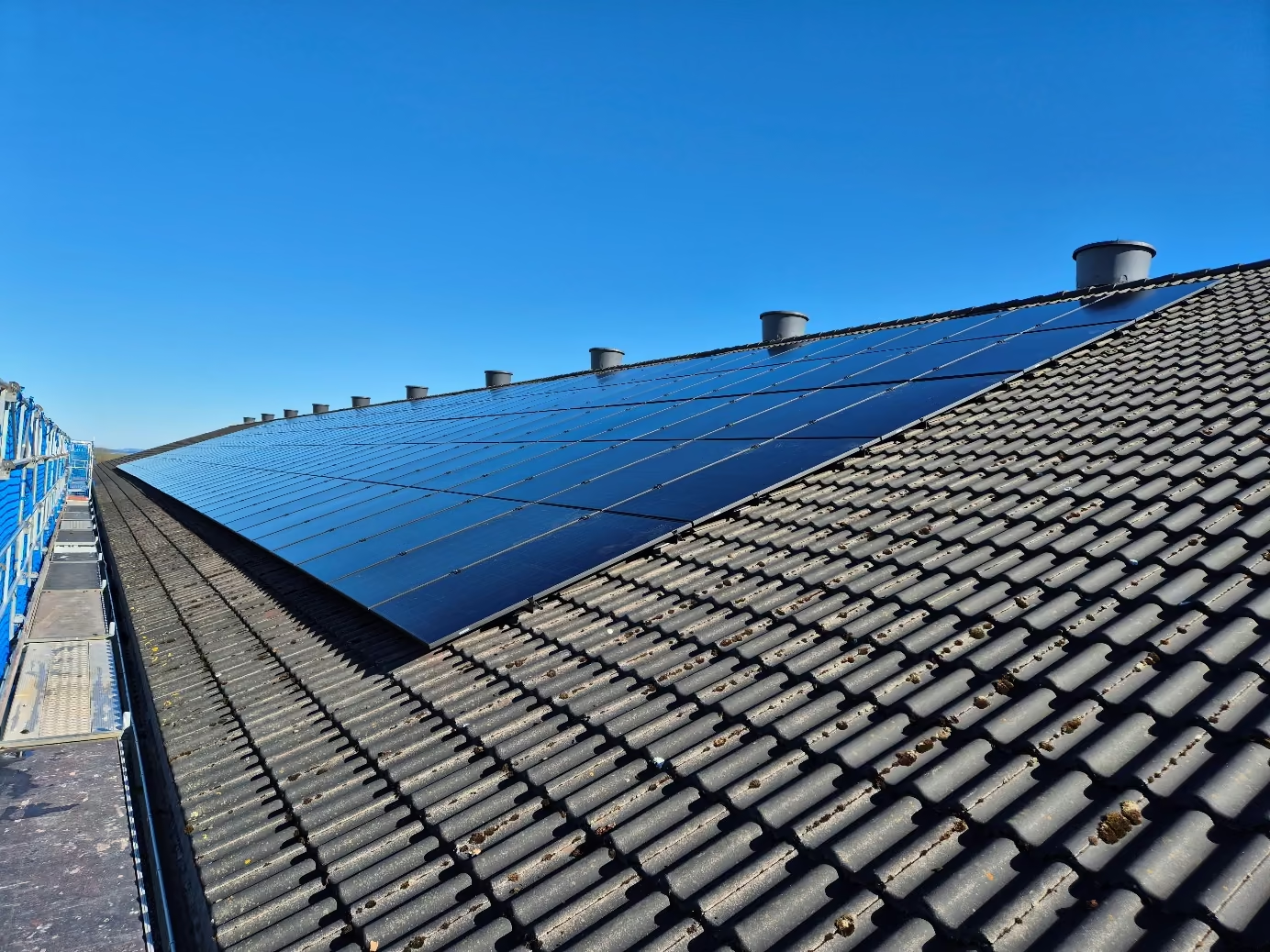
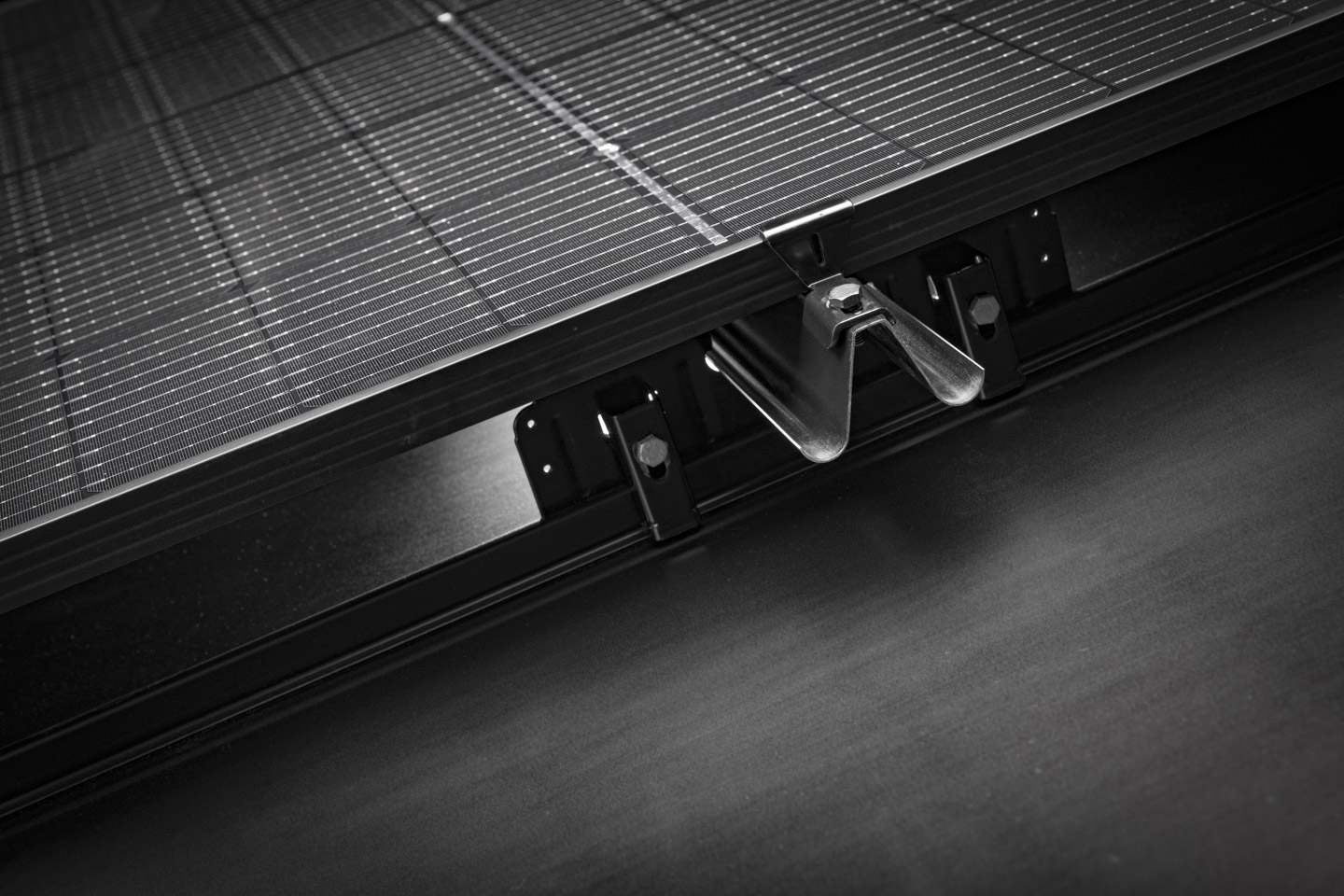
The practical difference compared with other systems comes down to time saved, Kristian says. Telescopic rails adjust to length without constant cutting, which reduces material waste. The brackets lock into place quickly, leaving fewer loose parts on the roof. Fewer components and faster work add up to real savings on every project.
Deliveries to Norway have run smoothly, and no separate technical support has been needed so far.
Two poultry farms facing the open sea
As an example of recent projects, Kristian points to two poultry farms on an island off Stavanger. The systems are 109 kWp and 185 kWp. The installations went ahead without problems, and the customer was very pleased with the result.
The location says the essential thing: an island facing the open sea is where a mounting system has to deliver on its promise every single day.
On this coast the cheap option turns out expensive
How do local conditions ultimately shape Astera's choice of equipment?
They push us toward components designed for this climate, not just certified to a generic standard. We prioritise high corrosion resistance, verified wind and snow load ratings, and fastening that handles strong uplift. We choose the durable option over the cheapest every time, because on this coast the cheap option is the expensive one within a few years.
Finally, we asked what Kristian would say to another company in the field considering RAULI.
If you are building for Nordic conditions, it is worth trying a system that was actually designed for them. For us the combination of Nordic steel, fast installation and ratings dimensioned for real loads was a clear choice. The best advice, though, is to try the system on a project of your own and see how it performs on the roof.
Summary
The projects Astera Solar has delivered are concrete evidence of what Nordic conditions demand from a mounting system:
- The conditions give no quarter. Wind uplift, heavy snow, salt air and freeze-thaw cycles work on the structures year after year.
- The mounting determines the whole. Even the best panels will not save a system if the mounting fails.
- A long horizon. When the contract and service life run 10 to 30 years, every component choice is a long-term commitment.
- The North demands solutions of its own. Demanding conditions call for technology built for them. RAULI is built to withstand Nordic weather.
The expert contributor to this article was Kristian Prestrud Astad, Chief Technology Officer, Astera Solar.






.png)